Watch: Full Investigation
Did Lee County Follow Its Own Evacuation Plan?
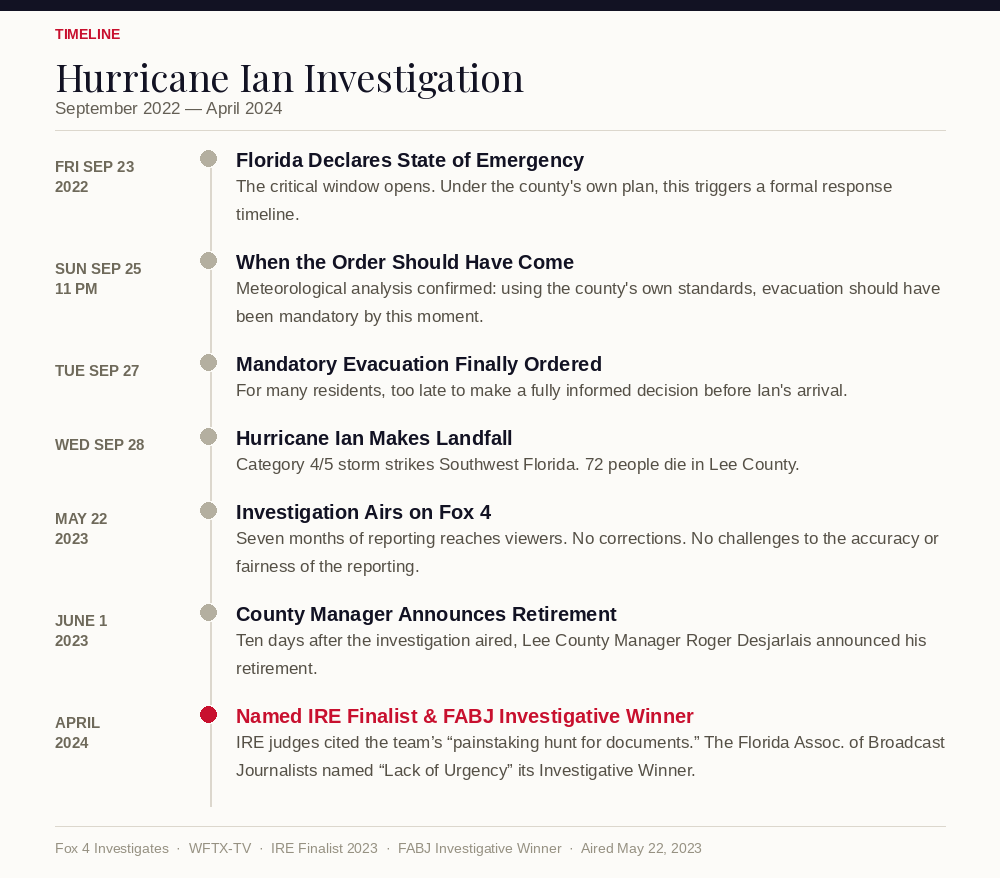
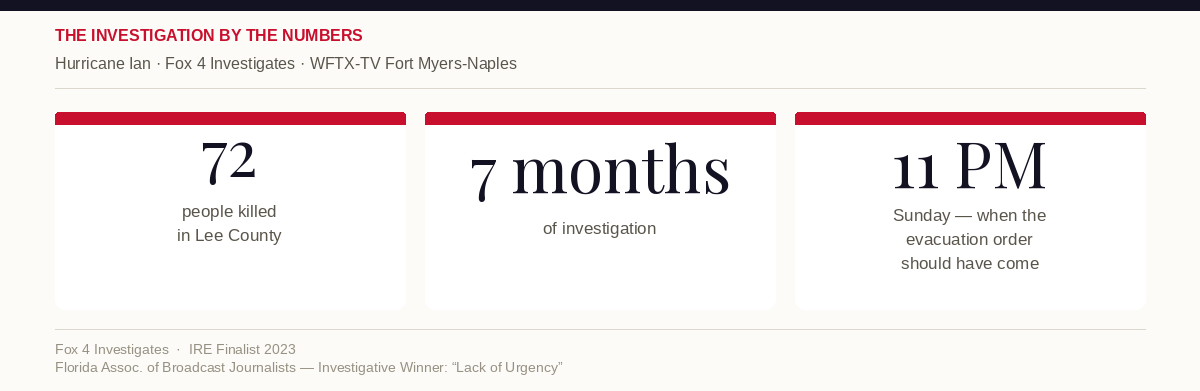
When Hurricane Ian killed 72 people in Southwest Florida, we already had a question. What followed was seven months of records requests, meteorological analysis, and survivor testimony. all in pursuit of a bulletproof answer.
The Question
We knew something was wrong before Hurricane Ian made landfall. As a Category 4/5 hurricane bore down on Southwest Florida in late September 2022, we watched Lee County's emergency messaging in real time. The county manager's tone was wrong — soft when it needed to be urgent. "If you're feeling unsafe, it's okay to go now." Language that nudged rather than warned.
Less than 15 hours later, he issued mandatory evacuations. By then, for many people in Lee County, it was too late to make an informed decision. When the death toll began to climb — ultimately reaching 72 — the question was already forming: did the county follow its own emergency management plan?
How We Reported It
The investigation had two distinct phases. Phase one was foundational: reconstructing the county's decision-making timeline through records. We filed public records requests targeting the county's emergency management plan, internal communications during the critical window, and meteorological data from NOAA and the National Hurricane Center.
When the county stonewalled us — delaying responses, producing incomplete records — we brought in the E.W. Scripps legal team and compelled production. Phone records, obtained using investigative budget, helped us understand how county leadership was communicating during those critical hours.
The meteorological data required specialist interpretation. Storm surge modeling, barometric pressure timelines, and wind field projections are technically complex. We brought our staff meteorologists in as full analytical partners — and their analysis confirmed one of the investigation's most significant findings: under the county's own plan, the evacuation order should have been issued as early as 11 p.m. Sunday night.
Phase two brought in our evening anchor as the investigative reporter of record — a strategic editorial decision. The story needed someone who could earn trust from survivors still living with trauma, conduct a credible accountability interview with the county manager, and hold the emotional and factual threads of a complex narrative together.
She secured survivor interviews on Fort Myers Beach that gave the investigation its human dimension. She pressed the county manager on his claim that the evacuation timing was "really very good" — a claim that collapsed under the weight of the meteorological data and the survivors' own testimony.
Watch: Lee County Manager Retiring
What Followed
Ten days after the investigation aired, Lee County Manager Roger Desjarlais announced his retirement. There were no corrections. No challenges to the reporting's accuracy or fairness.
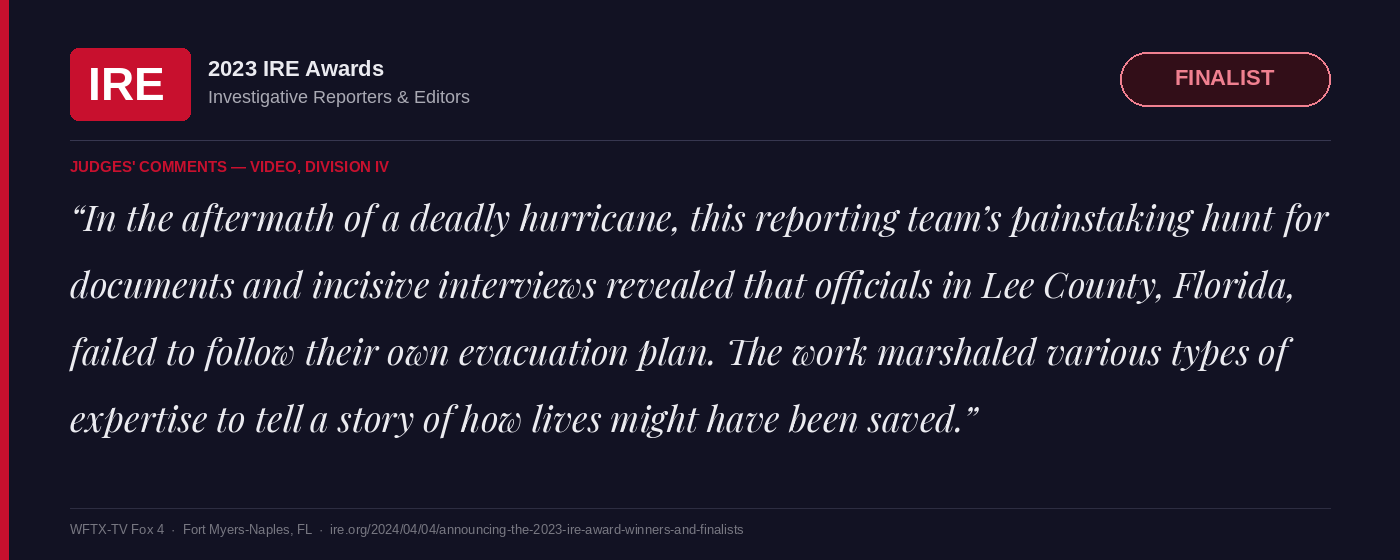
The investigation was recognized as a finalist by Investigative Reporters and Editors and honored by the Florida Association of Broadcast Journalists as its Investigative Winner for 'Lack of Urgency.'
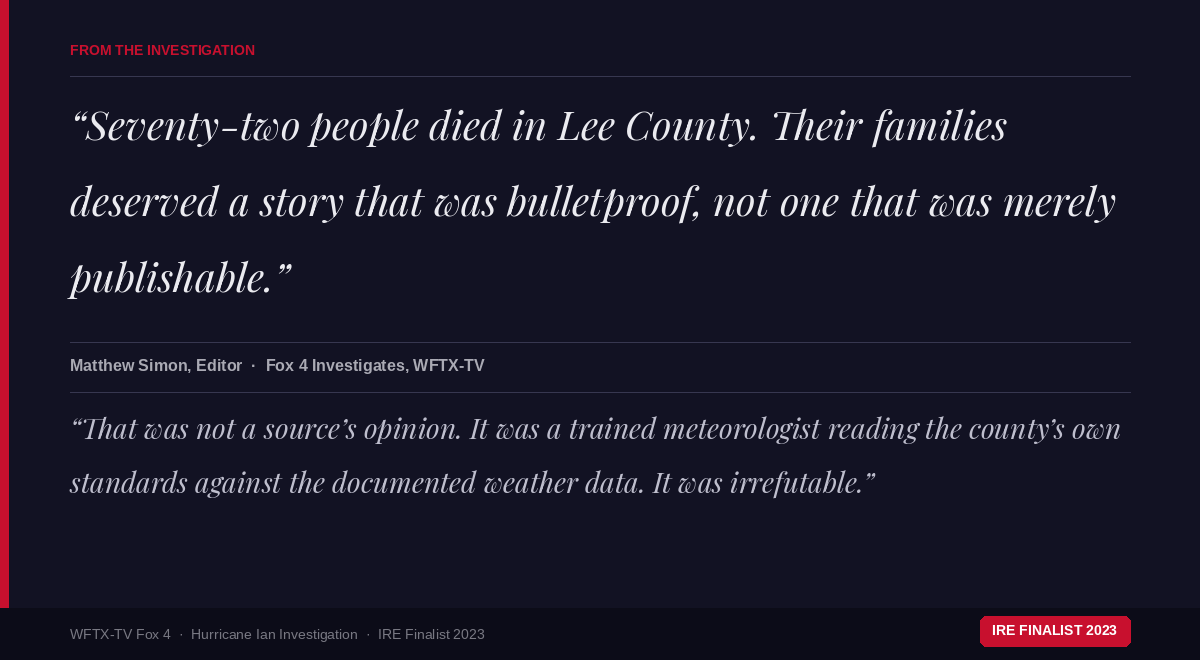
What mattered most wasn't the awards. It was that we didn't rush. Legacy newsrooms, under pressure from shrinking resources and accelerating news cycles, increasingly make the calculus that good enough and fast beats excellent and patient. We rejected that calculus. Seventy-two people died. Their families deserved better.